Mississippi River Floods and Ground Hog Day
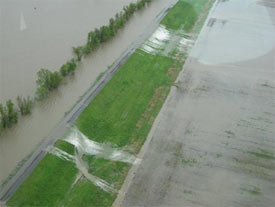 It's that time of year again. The news is full of record Mississippi River flood crestings. This year the focus is down river. Other years it's been the Upper Miss. Regardless of the river section, there’s an annual set of competing forces: Will the river win? Will the people or the land win? Who will suffer more and who will be affected less by the rising water? This seasonal ritual has elements of that old movie Ground Hog Day. It's that time of year again. The news is full of record Mississippi River flood crestings. This year the focus is down river. Other years it's been the Upper Miss. Regardless of the river section, there’s an annual set of competing forces: Will the river win? Will the people or the land win? Who will suffer more and who will be affected less by the rising water? This seasonal ritual has elements of that old movie Ground Hog Day.
Every year we witness the same story. The snow melts, the water rises and the Mississippi River finds new ways to make its way to the Gulf of Mexico. Some years - and this is one of them - are worse than others. Essentially it goes like this: millions of dollars are spent every year on sandbags, dams and/or levy explosions. We never seem to get ahead of the issue to find whole-river-system approaches to this increasingly expensive and humanly tragic national spring experience. Solutions aren't evident or easy. But does that mean we need to be trapped in the hydrological equivalent of Ground Hog Day?
It's time for us to acknowledge, administratively and policy-wise, what scientists have told us for some time: the Mississippi River is a whole watershed system and we should be planning and anticipating action that treats it as such, especially when it comes to flood management.
Unfortunately our advanced knowledge of the Mississippi River as a water system isn't matched by an equally modern administrative policy structure. We find ourselves trapped in a decision-making model based on geography and engineering parameters set in place nearly a century ago. We still make decisions based on events in one or two locations or on river engineering principles, rather than holistic water-system approaches.
As long ago as 1935, Frank Thone wrote in the Science News-Letter about a brave new future that would call for bold and broad national approaches to water. He was responding to the Mississippi River floods of 1927, blogger and hydrologist Matt Garcia writes in Hydro-Logic. Thone wrote then, "Out in front of the rest of us, there are pioneers of larger cooperation, who [ ] have evolved the beginnings of a full-sized national scheme for making the most of our national resources in water." He continued, "For a 'sample river' to use in drawing up their first model plan they chose boldly - no less than the Mississippi system itself…." He would cringe to see we haven't made good on those visions yet.
It doesn't have to be this way. Just as democracy in the world is teaching us there are different ways to make decisions as nations, we have new technology we could use to address the whole Mississippi River watershed. We could anticipate action in an overall context, instead of as it comes down the river in the spring. We could create a blue print for flood plain management and then take action within a context that addressed the whole river. Most importantly, we could come up with new ideas based on the input of people - both expert and non-expert together - who live along the river and actually do the sandbagging, live with the flooding, and have their livelihoods impacted.
Just as Phil Connors finally realizes in the movie Ground Hog Day, it's time we re-examine the way we've always done things. In the case of America's Great River, it's time we come up with new approaches instead of reliving the same disasters every spring. And, it's time we tapped the technology of the internet and the people of the River to find approaches to match the greatness of the Mississippi.
Please comment on our Facebook page.
For Some Historical Perspective… On Mississippi River floods, check out http://mississippivalleytraveler.com/floods-along-the-mississippi-river/
Waters of the United States
  Last month, U.S. Environmental Protection and Army Corps of Engineers announced in Milwaukee their development of a draft guidance for determining whether a water body, waterway, or wetland is protected by the Clean Water Act. They're now looking for comment over the next 60 days or so. The draft is intended to giver clearer, more predictable guidelines. Those who share our interest in whole Mississippi River approaches should go to http://water.epa.gov/lawsregs/guidance/wetlands/CWAwaters.cfm to comment. Last month, U.S. Environmental Protection and Army Corps of Engineers announced in Milwaukee their development of a draft guidance for determining whether a water body, waterway, or wetland is protected by the Clean Water Act. They're now looking for comment over the next 60 days or so. The draft is intended to giver clearer, more predictable guidelines. Those who share our interest in whole Mississippi River approaches should go to http://water.epa.gov/lawsregs/guidance/wetlands/CWAwaters.cfm to comment.
And the Winner Is…..
 We heartily congratulate the National Great Rivers Research and Education Center on its selection by the Clean Water America Alliance as one of the recipients of this year's United States Water Prize. The Water Prize honors individuals, institutions and organizations that are making outstanding advancements in the realm of sustainable water solutions. Congrats go to Dr. Dale Chapman, chair of NGRREC and an America's Waterway board member, Dr. Rip Sparks, director of research for NGRREC and all the NGRREC people who so ably address water sustainability issues through their Misssissippi River-based laboratory and programs. We heartily congratulate the National Great Rivers Research and Education Center on its selection by the Clean Water America Alliance as one of the recipients of this year's United States Water Prize. The Water Prize honors individuals, institutions and organizations that are making outstanding advancements in the realm of sustainable water solutions. Congrats go to Dr. Dale Chapman, chair of NGRREC and an America's Waterway board member, Dr. Rip Sparks, director of research for NGRREC and all the NGRREC people who so ably address water sustainability issues through their Misssissippi River-based laboratory and programs.
|