 We rarely stop to think about the vastness of the Mississippi River as a resource to the United States. We might acknowledge its role in the development of the U.S. But we rarely include its economic and ecological significance today. If we did, we'd do more to treat it as the monumental resource that it is.
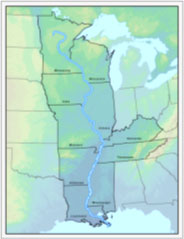
Just how much of a monumental resource is it? First, there's its sheer size. The Mississippi's drainage basin is the third largest in the world, and it's the largest river system in North America. Covering over 2,500 miles, it drains 41 percent of the continental U.S. Thirty one states and two Canadian provinces are included in the watershed, accounting for between 1.2 and 1.8 million square miles. Whew! That's big.
Then there's the water supply it provides. Different studies at different times claim that between 15 million and 18 million people rely on the Mississippi River - or its tributaries - for their water supply. The EPA states 50 cities rely on the Mississippi River for daily water supply. And that doesn't include wildlife.
But if we take wildlife into account, some sources estimate that possibly 25 percent of all fish species in North America are part of the Mississippi River system. Forty percent of our nation's migratory waterfowl use the river corridor during Spring and Fall. Sixty percent of all North American birds use the Mississippi as their migratory flyway. The upper Mississippi River area hosts 50 mammal species. (This probably is conservative.) And at least 145 amphibians and reptile species peruse the area as well.
Then we come to the Mississippi's role as an economic resource. This isn't documented on a system-wide basis so it's difficult to measure. Collecting this data system wide is another necessary step to creating whole-River approaches to the Mississippi. For now, here's some of what we know.
Take tourism. Countless River communities use their heritage and location to attract tourists and bring additional revenue to their towns. The Mississippi River Parkway Commission is dedicated to tourism on all river segments and is facilitating federal grants for local communities. Highways and bike trails promote access.
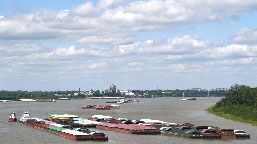 Then there's barge transportation. Total tonnage on the River is collected only in segments, but for now let's just say that in 2004 sixty percent of all grain exported from the U.S. was shipped via the Mississippi River through the port of New Orleans and South Louisiana. This doesn't include the petroleum and petroleum products, iron and steel, paper and wood, coffee, coal and chemicals that are shipped via the Mississippi and its ports. Then there's barge transportation. Total tonnage on the River is collected only in segments, but for now let's just say that in 2004 sixty percent of all grain exported from the U.S. was shipped via the Mississippi River through the port of New Orleans and South Louisiana. This doesn't include the petroleum and petroleum products, iron and steel, paper and wood, coffee, coal and chemicals that are shipped via the Mississippi and its ports.
Fishing and seafood. Again, data is dispersed but we know that Louisiana's $2.5 billion seafood industry is threatened by hypoxia - the result of explosive algae growth from upstream fertilizer in what is the country's highest producing agricultural region.
And while hydropower from the Mississippi pioneered the lighting of numerous American cities in their early years, the development of improved hydro electric turbines is providing new opportunities for the Mississippi to return to producing electricity in renewable and more ecologically sound ways.
So what are we doing to protect and enhance such a monumental resource as the Mississippi River? The anomaly is that the Mississippi River's vastness is both its source of significance and the reason for its disparate treatment. That may be coming to an end. The Midwest Natural Resources Group has put forward a recognition document signed by representatives of many organizations - from the Army Corps of Engineers to the Bureau of Indian Affairs and from Homeland Security to the Fish and Wildlife Service - calling for an integrated vision for natural resource sustainability and a holistic approach to America's Waterway - the Mississippi.
That's a start. But a holistic approach needs the input and involvement of River residents as well as judicatory bodies. There are ways to tap this public dimension -- like our own National Dialogue for the Future of America's Waterway - that are based on a deliberative, community-of-interest model. It will take such efforts - and probably more - to come up with the kind of approach worthy of the Mississippi River - America's monumental resource.
This Month on the Mississippi River:
Upper Midwest Environmental Sciences Center Celebrates 50 Years
Founded in 1959 as a "fish lab", the UMESC has quietly published over a thousand scientific papers, developed new drug treatments for fisheries and provided a body of knowledge to guide the management of one of the nation's great waterways. Now the UMESC's mission is to provide the scientific information needed by resource managers, decision makers and the public to protect, enhance and restore ecosystems in the Upper Mississippi River basin, the Midwest and the world. They're in a good position to do so. $6.5 million was included in the stimulus package to build maintenance and additional office space for the 65-acre campus, and they stand to get about $4 million for research through the Great Lakes Restoration Initiative.
River Action to Meet for 2nd Annual Upper Mississippi River Conference
Sept. 23 - 25 will see this conference taking place in Moline, Ill. Field trips, workshops and networking will be in order at the conference that is slated to include River Action's 25th Anniversary banquet. Check out www.riveraction.org/umrc2009/ .
Mississippi River Parkway Commission Annual Meeting in Red Wing, Minn.
The MRPC meets this month as well, Sept. 24-26, in Red Wing, Minn. - one of the charming upper Mississippi River towns. Founded in 1938 by the FDR administration, the national MRPC is the umbrella organization that works on behalf of multi-state organizations to collectively preserve, promote and enhance the scenic, historic and recreational resources of the Mississippi River. One of their programs: The Great River Road. |