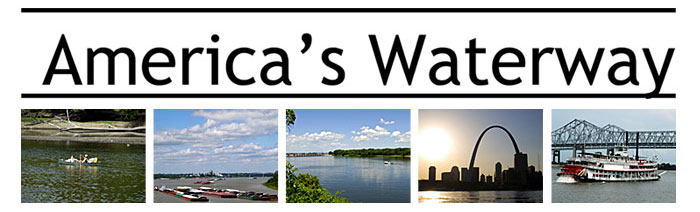
A Unified Mississippi River - The Missing Link
After a flurry of editorials, blogs and web postings on the need for revised Mississippi River's management strategies in the wake of early summer floods, new articles are appearing calling public attention to doing things differently on the River. The calls plead for stronger regulation, more creative thinking, and, at the very least, federal recognition that 1930's-based plans for the Mississippi River should be revised to reflect today's Mississippi River.
Most of the time, we see their reasoning. However, they miss a crucial point:
 Calls for changes in policy - whether in response to specific events or as a result of research findings - don't get results without a key ingredient: Voters. Policy changes don't happen just because reasoning is sound. They happen because the people who elect the decision makers unify and ask their elected officials to do something. All the articulate editorials and all the thorough research won't result in new strategies for the whole Mississippi River. Unified action by the people in Mississippi River-based communities will. Calls for changes in policy - whether in response to specific events or as a result of research findings - don't get results without a key ingredient: Voters. Policy changes don't happen just because reasoning is sound. They happen because the people who elect the decision makers unify and ask their elected officials to do something. All the articulate editorials and all the thorough research won't result in new strategies for the whole Mississippi River. Unified action by the people in Mississippi River-based communities will.
A unified Mississippi River community, or constituency, is the missing link to new, future, and whole river approaches. We all decry the absence of whole-watershed or whole-river approaches to the Mississippi River that fit with its present and future role as America's Waterway. What we overlook is that most of the people who seek these new strategies are spread throughout the Mississippi River watershed - a vast area roughly equivalent to 31 states or two-thirds of the country. This results in wide and disparate appeals to not only federal, but state, county and municipal authorities, further jumbling the mix of regulatory approaches to the Mississippi River. Without realizing it, we're contributing to a continuation of the problem of disjointed and geo-politically-driven approaches to the River. If we don't take time to build a unified constituency around citizen-based goals for the Mississippi, we'll just keep producing the place-based solutions of the past.
What's needed is not only a unified approach to the future of the Mississippi River, but also a unified constituency capable of supporting and advocating that approach. Building a constituency may seem like a distraction, but it's one of those necessary policy building blocks, like research, funding and promotion. As advocates for the River, we've done all of the above... EXCEPT build the constituency.
It's not too late. Since there's been an awakened public sense of the Mississippi River as a watershed system, now is the time to act. We at America's Waterway believe civic engagement processes are best for building the common ground needed for a whole-river constituency. We see the deliberative democracy approach of AmericaSpeaks, conducted in a National Dialogue for the Future of the Mississippi River, as the avenue for building a whole-Mississippi-River constituency.
But we'd like to hear from you. What do you think about a constituency for the Mississippi River? Do you agree the Mississippi needs a constituency of its own? Are you interested in helping us build one? You can reach us on Facebook or join the discussion on Twitter. Or leave us a comment on our blog. Join with us to build the missing link for the Mississippi River.
 World Rivers Day-Sept. 25 World Rivers Day-Sept. 25
Launched in 2005 as a complement to the United Nations' Decade of Water for Life, this world recognition of the importance of rivers to sustainable life and livelihood is marked each year on the last Sunday of September. It is meant not only as a day of public recognition, but also as a day to focus on stewardship of rivers. Make the Mississippi River your focus this coming Sept. 25.
Security & Sustainability Forum - Sept 28 with Lynn Scarlett
 The former Interior Department Deputy Secretary Lynn Scarlett will host a panel discussion webinar that features, among others, Paul Harrison, sr. director of the Environmental Defense Fund's Mississippi River Delta Restoration Project and focuses on Adaptations to Protect Physical Infrastructure in a Changing Climate. The webinar is free and part of a 5-part series for practitioners in government, industry and academia. To learn more and register: http://securityandsustainabilityforum.org/new/ The former Interior Department Deputy Secretary Lynn Scarlett will host a panel discussion webinar that features, among others, Paul Harrison, sr. director of the Environmental Defense Fund's Mississippi River Delta Restoration Project and focuses on Adaptations to Protect Physical Infrastructure in a Changing Climate. The webinar is free and part of a 5-part series for practitioners in government, industry and academia. To learn more and register: http://securityandsustainabilityforum.org/new/
 National Great Rivers Research and Education Center National Great Rivers Research and Education Center
to Host 1st Biennial RiverWatch Symposium
Oct. 4 stream stewards, teachers, environmentalists, students and retired researchers and business people will gather in Peoria, Illinois to review a RiverWatch Progress Report and recognize recipients of the River Citizen Award. The RiverWatch Progress Report is expected to reveal over 15 years of data gathered by these stalwart Citizen Scientists throughout Illinois.
Mississippi River Cultural Highlight:
Memphis' Mud Island Mississippi River Scale Model
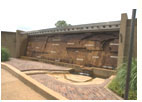 If you, like many in the U.S., wondered through the summer why the Mississippi River does what it does when it floods, this model tells the story. An engineering feat in itself, this model replicates the twists and turns of America's Waterway, its ups and downs, and its cities and dams. In a five-block area, this model addresses the question: Is the Mississippi River a force of nature or a force of engineering design? If you, like many in the U.S., wondered through the summer why the Mississippi River does what it does when it floods, this model tells the story. An engineering feat in itself, this model replicates the twists and turns of America's Waterway, its ups and downs, and its cities and dams. In a five-block area, this model addresses the question: Is the Mississippi River a force of nature or a force of engineering design? |